Skip to article frontmatterSkip to article content

Cardinality

Cardinal numbers capture the notion of the cardinality of a set. We measure the cardinality of a set relative to other sets by saying sets a,ba,b have the same cardinality if there exists a bijection between them.

We use the following notation:

ab: there exists a bijection abab: there exists an injection abab:ab    ab\begin{align*} a \sim b \quad & : \Leftrightarrow \quad \text{ there exists a bijection } a \leftrightarrow b \\ a \preceq b \quad & : \Leftrightarrow \quad \text{ there exists an injection } a \hookrightarrow b \\ a \prec b \quad & : \Leftrightarrow \quad a \preceq b \; \wedge \; a \nsim b \end{align*}

It is straightforward to show \sim is an equivalence relation and that \preceq is transitive. \preceq is obviously also reflexive. Relations that are reflexive and transitive are called preorders. If we mod out by \sim, do we get a partial order? In other words, do we have antisymmetry in the form

ab    ba?ab.a \preceq b \; \wedge \; b \preceq a \quad \overset{?}{\Rightarrow} \quad a \sim b.

This follows pretty easily if we use the Axiom of Choice (in form of the well-ordering principle WO\WO), but it is one of the few fundamental results in the theory of cardinality one can prove without using Choice.

Proof

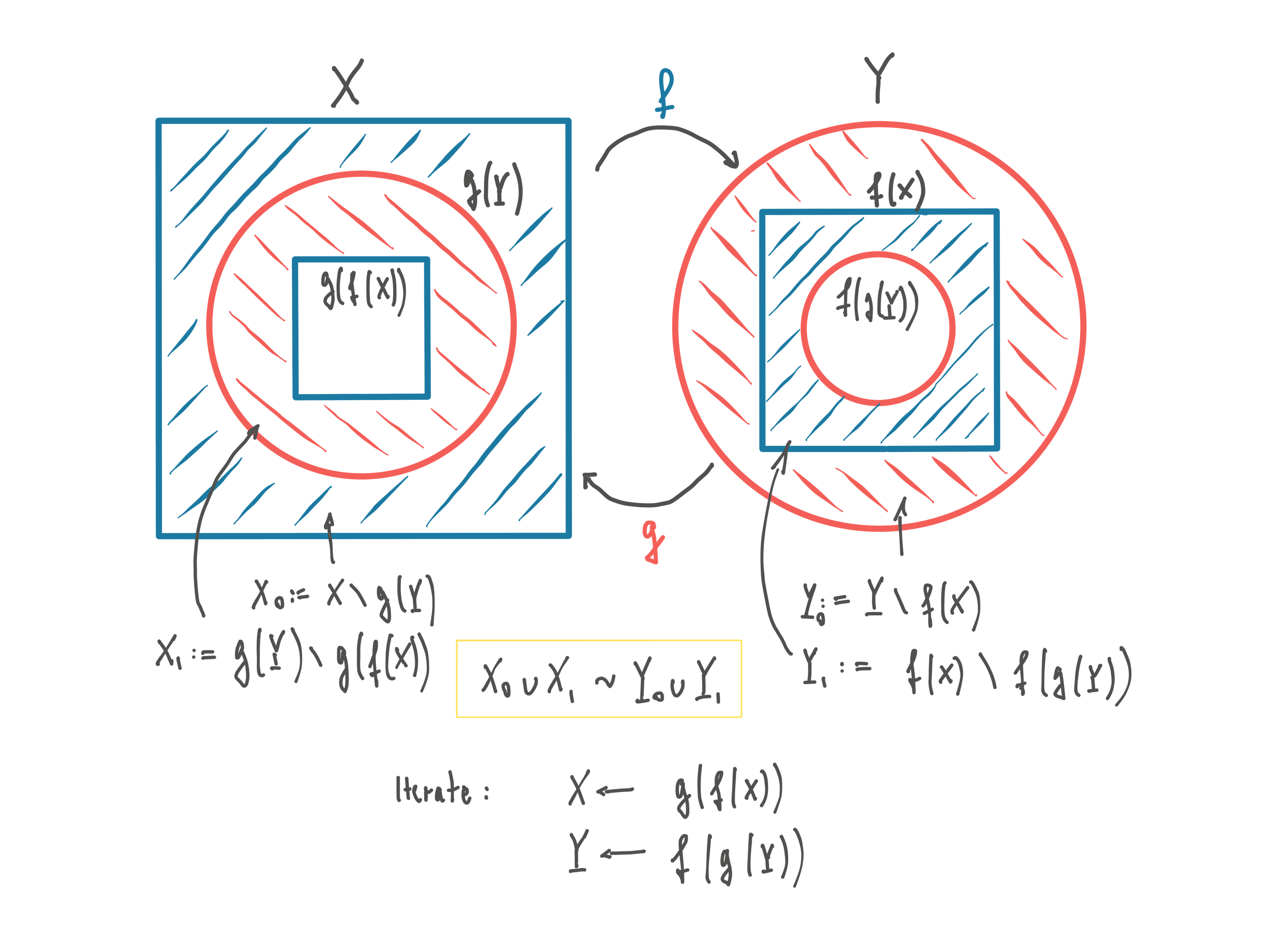
Let X0=Xg(Y)X_0 = X\setminus g(Y), Y0=Yf(X)Y_0 = Y \setminus f(X). Let X1=g(Y)g(f(X))X_1 = g(Y)\setminus g(f(X)), Y1=f(X)f(g(Y))Y_1 = f(X) \setminus f(g(Y)). Note that there is a bijection between  X0X1X_0 \cup X_1 and Y0Y1Y_0 \cup Y_1 by letting

φ(x)={f(x) if xX0,g1(x) if xX1.\varphi(x) = \begin{cases} f(x) & \text{ if } x \in X_0, \\ g^{-1}(x) & \text{ if } x \in X_1. \end{cases}

Iterate this process with new X:=g(f(X))X : = g(f(X)) and Y:=f(g(Y))Y := f(g(Y)). This gives rise to sequences of pairwise disjoint sets X0,X1,X2,X_0, X_1, X_2, \dots and Y0,Y1,Y2,Y_0, Y_1, Y_2, \dots , together with a bijection

φ:iωXiiωYi.\varphi: \bigcup_{i \in \omega} X_i \leftrightarrow \bigcup_{i \in \omega} Y_i.

We now define

h(x)={φ(x) if xiωXi,f(x) if xXiωXi.h(x) = \begin{cases} \varphi(x) & \text{ if } x \in \bigcup_{i \in \omega} X_i, \\ f(x) & \text{ if } x \in X\setminus \bigcup_{i \in \omega} X_i. \end{cases}

It is clear that hh is one-to-one. Suppose yYiωYiy \in Y \setminus \bigcup_{i \in \omega} Y_i is not in f(XiωXi)f(X\setminus \bigcup_{i \in \omega} X_i). But then, by definition of φ\varphi, yy is not in f(Y)f(Y), which would imply yY0y \in Y_0, contradiction. Hence hh is onto.

The next result shows that this order is linear. To prove it, we have to use Choice.

Proof

By the well-ordering principle WO\WO, there exist ordinals α,β\alpha, \beta such that aαa \sim \alpha and bβb \sim \beta. Since any two ordinals are comparable by <<, Proposition 4 implies that αβ\alpha \subseteq \beta or βα\beta \subseteq \alpha, which easily yields the theorem.

Cantor’s famous result shows that for every set there exists one with greater cardinality. In particular, the order \preceq is infinite. Given a set aa, we denote its power set by P(a)\Pow(a),

P(a)={b ⁣:ba}.\Pow(a) = \{ b \colon b \subseteq a \}.
Proof

x{x}x \mapsto \{x\} is an injection from aa to P(a)\Pow(a), hence aP(a)a \preceq \Pow(a). Now assume aP(a)a \sim \Pow(a) via a bijection ff. We use a diagonal argument (as for the case a=Na = \N) to derive a contradiction. Let d:={xa ⁣:xf(x)}d: = \{x \in a\colon x \notin f(x) \}. As ff is onto, there exists bab \in a with f(b)=df(b) = d. But then

bd    bf(b)    bd,b \in d \; \Leftrightarrow \; b \notin f(b) \; \Leftrightarrow \; b \notin d,

contradiction.

Cardinal numbers

As with ordinals, we would like to choose a system of representatives for the equivalence classes under \sim. Theorem (Hartogs) suggests to use ordinals (which we can compare using the well-ordering of ordinals). We therefore assume the Axiom of Choice (so every set has a well-ordering). One issue that remains is that a set can have well-orderings of different lengths (as we saw in the case of the natural numbers N\Nat). But since the ordinals are well-ordered, we can choose the least one of the same cardinality.

An ordinal κ{}\kappa is a cardinal if it is the cardinality of some set. Equivalently, κ{}\kappa is a cardinal if

β<κ  βκ.\forall \beta < \kappa \; \beta \prec \kappa.

We usually use Greek letters from the middle of the alphabet, κ,μ,ν,\kappa, \mu, \nu, \dots to denote cardinals.

Given a cardinal κ{}\kappa, we let κ+\kappa^+ be the cardinal successor of κ{}\kappa, i.e.

κ+= least cardinal ν with κν.\kappa^+ = \text{ least cardinal } \nu \text{ with } \kappa \prec \nu.

By Cantor’s Theorem (and the Axiom of Choice), we have

κκ+P(κ),\kappa \prec \kappa^+ \preceq |\Pow(\kappa)|,

and as ordinals,

κ<κ+P(κ).\kappa < \kappa^+ \leq |\Pow(\kappa)|.

All finite ordinals

0,1,2,3,0, 1, 2, 3, \dots

are cardinals. The first infinite cardinal is ω{}\omega, the cardinality of all countably infinite sets.

We can use ordinals to enumerate all infinite cardinals. This gives the aleph-sequence.

0  :=  ωα+1  :=  α+λ  :=  sup{β ⁣:β<λ}\begin{align*} \aleph_0 & \; := \; \omega\\ \aleph_{\alpha+1} & \; := \; \aleph^+_\alpha \\ \aleph_\lambda &\; := \; \sup \{ \aleph_\beta \colon \beta < \lambda \} \end{align*}

As in the case of ordinals, cardinals of the form α+1\aleph_{\alpha+1} are called successor cardinals, whereas alephs whose index is a limit ordinal are called limit cardinals.

Proof (Sketch)

The mapping αα\alpha \mapsto \aleph_\alpha is stricly increasing. By Proposition 1, κκ\kappa \leq \aleph_\kappa and hence κ<κ+1\kappa < \aleph_{\kappa+1}. Choose α{}\alpha minimal such that κ<α\kappa < \aleph_\alpha. A simple case distinction yields that α{}\alpha must be a successor ordinal, α=β+1\alpha = \beta+1. It then follows from β+1=β+\aleph_{\beta+1} = \aleph_\beta^+ that κ=β\kappa = \aleph_\beta.

While every cardinal is an ordinal, not every ordinal is a cardinal. For example

0=ω=ω+1=ω+2==ω+ω=Z=N×N=Q.\aleph_0 = \omega = |\omega +1| = | \omega +2|= \ldots = |\omega+ \omega| = | \mathbb{Z}| = |\mathbb{N} \times \mathbb{N}| = | \mathbb{Q}|.

The next cardinal is

1=0+=ω1={αOrd ⁣:α countable}.\aleph_1 = \aleph_0^+ = \omega_1 = \{\alpha \in \Ord\colon \alpha \text{ countable}\}.

Between 0\aleph_0 and 1\aleph_1 are uncountably many ordinals, all of which are countable. The ordinal ω1\omega_1 will play an important role when we close sets under countably infinite operations (like the Borel sets).

We know the set of reals is uncountable, so at this time we are able to conclude

R1,P(R)2,|\mathbb{R}|\ge \aleph_1, \quad |\mathcal{P}(\mathbb{R})| \ge \aleph_2, \ldots

Operations on cardinals

What can we say about the cardinality of unions, products, etc.?

This is an instance of a more general result. We can define arithmetic operation on cardinals by looking at the cardinalities of the corresponding set theoretic operations.

κ+λ=(κ×{0})(λ×{1})(disjoint union)κλ=κ×λ(product)κλ={f ⁣:f:λκ}(exponentiation)\begin{align*} \kappa + \lambda \quad & = \quad |(\kappa \times \{0\}) \cup (\lambda \times \{1\})| & \qquad (\text{disjoint union}) \\ \kappa \cdot \lambda \quad & = \quad |\kappa \times \lambda | & \qquad (\text{product})\\ \kappa^{\lambda} \quad & = \quad |\{f \colon f: \lambda \to \kappa \}| & \qquad (\text{exponentiation}) \end{align*}

It turns out for infinite cardinals, ++ and \cdot are trivial. This is mostly due to the fact that there is a nice (canonical) well-ordering of Ord×Ord\Ord\times\Ord.

The canonical well-ordering of ordinal pairs

We define a bijection F:Ord×OrdOrdF: \Ord \times \Ord \leftrightarrow \Ord. As a first step, we define the lexicographic order <lex<_{\lex} on Ord×Ord\Ord \times \Ord:

(α,β)<lex(γ,δ):    α<γ(α=γβ<δ).(\alpha, \beta) <_{\lex} (\gamma, \delta) \quad : \iff \quad \alpha < \gamma \, \vee \, ( \alpha = \gamma \, \wedge \beta < \delta).

This is a linear order in which every non-empty subset has a minimal element, but we have to be careful since in this order all pairs of the form (0,ξ)(0,\xi), ξOrd\xi \in \Ord, precede (1,0)(1,0). And we saw that there is no set of the form {(0,ξ) ⁣:ξOrd}\{(0,\xi) \colon \xi \in \Ord\}. Gödel modified this order by presorting according to the maximum of the pair:

(α,β)<g(γ,δ)  :      max(α,β)<max(γ,δ)  (max(α,β)=max(γ,δ)(α,β)<lex(γ,δ)).\begin{align} (\alpha, \beta) <_g (\gamma, \delta) \; : \iff \; & \max(\alpha,\beta) < \max(\gamma,\delta) \\ & \qquad \vee \; (\max(\alpha,\beta) = \max(\gamma,\delta) \: \wedge \: (\alpha, \beta) <_{\lex} (\gamma, \delta)). \end{align}

This yields a linear order in which every element has only a set of predecessors. Moreover, the minimality condition is still satisfied: Let AOrd×OrdA \subseteq \Ord \times \Ord be non-empty. We find the least element of AA by

  • first finding the least γ0{max(α,β) ⁣:(α,β)A}\gamma_0 \in \{ \max(\alpha,\beta) \colon (\alpha,\beta)\in A\},
  • then finding the least α0{α ⁣:β  ((α,β)Amax(α,β)=γ0)}\alpha_0 \in \{\alpha \colon \exists \beta \;( (\alpha,\beta)\in A \wedge \max(\alpha,\beta) = \gamma_0) \},
  • and finally finding the least β0{β ⁣:(α0,β)Amax(α0,β)=γ0}\beta_0 \in \{\beta \colon (\alpha_0,\beta) \in A \wedge \max(\alpha_0,\beta) = \gamma_0 \}.

It is straightforward to verify that (α0,β0)(\alpha_0, \beta_0) is the smallest element of AA with respect to <g<_g.

Enumerating pairs of ordinals along <g<_g now yields and order isomorphism F:Ord×OrdOrdF: \Ord \times \Ord \to \Ord,

(α,β)<g(γ,δ)        F(α,β)<F(γ,δ).(\alpha, \beta) <_g (\gamma, \delta) \; \iff \; F(\alpha, \beta) < F(\gamma, \delta).

Note that f(α):=F(α×α)f(\alpha) := F(\alpha\times \alpha) is a strictly increasing map on ordinals, and hence by Proposition 1, f(α)αf(\alpha) \geq \alpha. Further note that

α×α={(β,γ) ⁣:(β,γ)<g(0,α)},\alpha \times \alpha = \{(\beta,\gamma) \colon (\beta,\gamma) <_g (0,\alpha) \},

hence α×α\alpha\times\alpha is a <g<_g-initial segment.

An important application of the well-ordering of Ord×Ord\Ord\times \Ord is the following theorem.

Proof

Show that for any infinite cardinal κ{}\kappa, the restriction of the mapping FF to κ×κ\kappa \times \kappa, Fκ×κF\Rest{\kappa\times\kappa}, is a bijection between κ×κ\kappa \times \kappa and κ{}\kappa. In other words, show that F(κ×κ)=κF(\kappa\times\kappa)=\kappa.

It is straightforward to verify this for κ=0\kappa = \aleph_0.

Now assume it does not hold for a larger cardinal. Since every infinite cardinal is of the form κ=α\kappa = \aleph_\alpha, choose α>0{}\alpha > 0 minimal such that F(α×α)αF(\aleph_\alpha \times \aleph_\alpha) \neq \aleph_\alpha.

Note that since fir any β\beta, F(β,β)βF(\beta,\beta) \geq \beta, we must have F(α,α)>αF(\aleph_\alpha, \aleph_\alpha) > \aleph_\alpha.

Since FF is a bijection, there exist ordinals β,γ<α\beta, \gamma < \aleph_\alpha such that F(β,γ)=αF(\beta, \gamma) = \aleph_\alpha. If we put δ=max{β,γ}+1\delta = \max\{\beta,\gamma\}+1, we have ωδ<α\omega \leq \delta < \aleph_\alpha (since α\aleph_\alpha has to be a limit ordinal).

Since (β,γ)<g(δ,δ)(\beta, \gamma) <_g (\delta, \delta), it follows that F(δ×δ)>αF(\delta \times \delta) > \aleph_\alpha and thus F(δ×δ)αF(\delta\times \delta) \supseteq \aleph_\alpha. The latter implies δ×δα|\delta \times \delta| \geq \aleph_\alpha. But δ×δ=δδ|\delta\times\delta| = |\delta|\cdot |\delta| and by minimality of α\alpha, δδ=δ<α|\delta|\cdot |\delta| = |\delta| < \aleph_\alpha, contradiction.

Proof

If κ\kappa is infinite, we have, by simple monotonicity arguments,

κκ+κκκ=κ,hence  κ+κ=κκ=κ.\kappa \le \kappa + \kappa \le \kappa \cdot \kappa = \kappa, \quad \text{hence} \; \kappa + \kappa = \kappa \cdot \kappa = \kappa.

If, say, 0<κλ0< \kappa \leq \lambda with λ\lambda infinite, the above implies

λκ+λλ+λ=λ, and thus   κ+λ=λ=max{κ,λ},λκλλλ=λ, and thus   κλ=λ=max{κ,λ}.\begin{align} \lambda \le \kappa + \lambda \le \lambda + \lambda = \lambda, & \quad \text{ and thus } \;\kappa + \lambda= \lambda = \max\{\kappa,\lambda\},\\ \lambda \le \kappa \cdot \lambda \le \lambda \cdot \lambda = \lambda, & \quad \text{ and thus } \; \kappa \cdot \lambda = \lambda = \max\{\kappa,\lambda\}. \end{align}

While, as we just saw, addition and multiplication are trivial for infinite cardinals, determining the simplest transfinite power, 202^{\aleph_0}, already leads to unsolvable problems. 202^{\aleph_0} plays an important role since it is the cardinality of the continuum.

We can draw some conclusions:

  1. With R=20|\R| = 2^{ \aleph_0} we also get Rn|\R^n | = (20)n=20,(2^{ \aleph_0})^n = 2^{\aleph_0}, by Hessenberg’s Theorem. It even holds that (exercise!)
{s ⁣:NR}=(20)0=200=20.|\{s \colon \N \to \R\}| = (2^{ \aleph_0})^{\aleph_0} = 2^{ \aleph_0 \cdot \aleph_0} = 2^{ \aleph_0}.

That is, there are as many countable sequences of real numbers as there are real numbers.

  1. Since every continuous real-valued function on R\R is determined by its values on Q\Q, we have

    {f:RR continuous }={f:QR}=(20)0=20.|\{f:\R \to \R \text{ continuous } \}| = |\{f:\Q \to \R \}| = (2^{ \aleph_0})^{\aleph_0} = 2^{ \aleph_0}.
  2. We obtain a higher cardinality by passing to the power set of the real numbers or to the set of all real-valued functions on R\R:

{f:RR}=P(R)=220>20.|\{f:\R \to \R \}| = |\Pow(\R)| = 2^{2^{ \aleph_0}} > 2^{ \aleph_0}.

CH\CH asserts that the cardinality of R\R is the next biggest cardinal after ω=0\omega = \aleph_0 (the cardinality of all countably infinite sets).